 |
 |
 |
 |
 |

 \
\
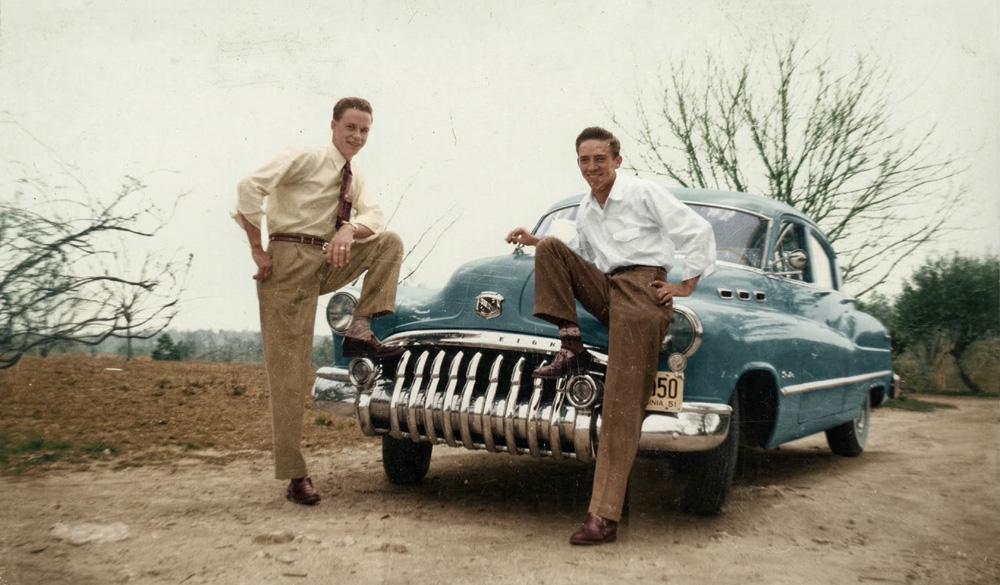
Franklin
and Pete Pike (1947)
|
Pete Pike was born November 30, 1929 in a tenant house in Amelia County, Virginia and was raised on the family seventy-acre. Raising cattle, and farming grain and tobacco were the money crops and was hard work and a good life. |
|
|
When
he was about twelve years old his Dad gave him and his brother,
Frank, and him their own little half-acre of tobacco and from
the profits earned from the sales, purchased a Gibson J 200 guitar
for himself and a Gibson F5 mandolin for Frank. Pete learned to
play guitar on a Sears and Roebuck guitar and an Ernest Tubb songbook.
|
|
|
Pete
began to practice and soon wrote his first song, Virginia Lou.
When he was about fifteen, Pete hooked up with a musician about
his same age named Buck Austin. Buck played the five-string banjo
in the Earl Scruggs style and they began playing together and
became lifetime buddies. Pete's first band consisted of Buck on
the banjo and singing tenor, Franklin on the mandolin, and Pete
on the guitar … and had the makings of a fine little "hillbilly"
band.
|
|
|
At
first, Pete was inspired by Vernon Dalhart, The Carter Family,
The Delmore Brothers, then came Roy Acuff and Bill Monroe. One
day Pete heard Bill and Charlie Monroe on a radio station out
of Greensboro North Carolina, before the two brothers split up,
and he just couldn't get enough of this 'Hillbilly' music.
|
|
|
Pete,
Buck, and Franklin began playing on Wednesday nights at a little
theater in the Village of Amelia, and when Pete was sixteen, his
dad started letting them play some with him and his uncle (who
was also the state champion fiddle player in the 1930's). This
gave them a lot of experience onstage and soon they were playing
a lot of dances in and around the Eastern Virginia area.
|
|
|
|
|
|
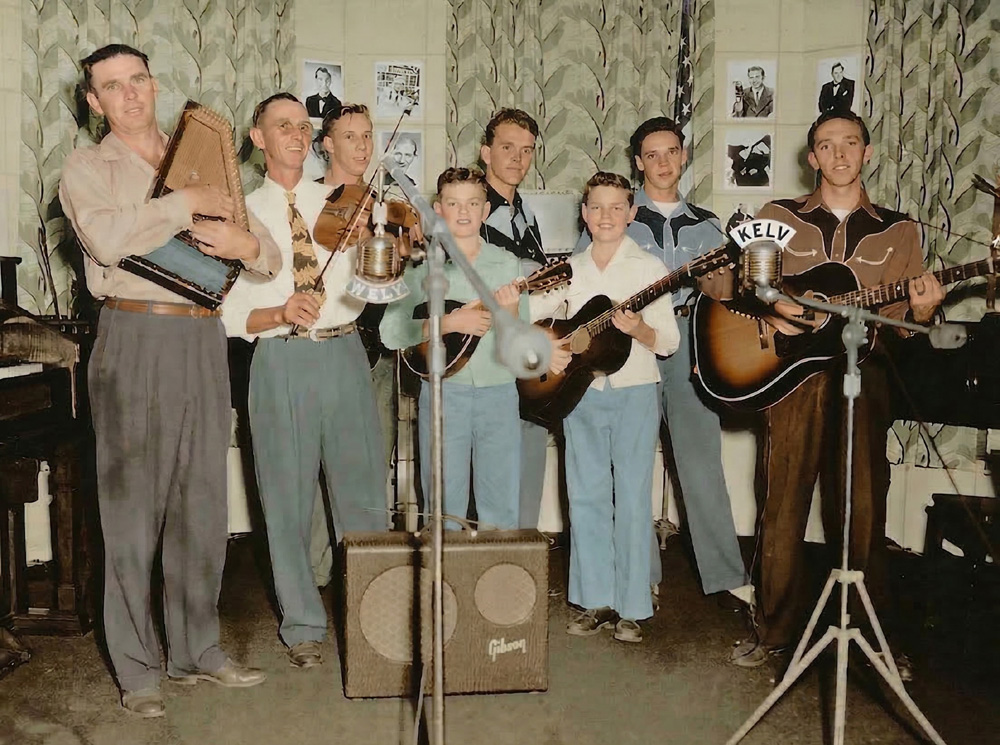
In
1947, the band played for the opening of the WKLV radio station
in Blackstone, Virginia. The manager, The first star he brought in was Little Jimmy Dickens and he called the show The Virginia Music Festival. It was very successful and one Saturday, while in the studio, Eddie said he would like to do this every year and began talking about what name it should be called. In those days, there was a program that came over the Mutual Network called The Renfro Valley Gang that sang a lot of the old folk songs and, with everyone's approval, decided to call it the Virginia Folk Music Association. The VFMA is still going on and the VFMA Festival which has moved from Blackstone, VA. to Chesterfield, Va., gets bigger and better each year with venues which include some of the top names in the Bluegrass world, as well as the new up and coming local artists. |
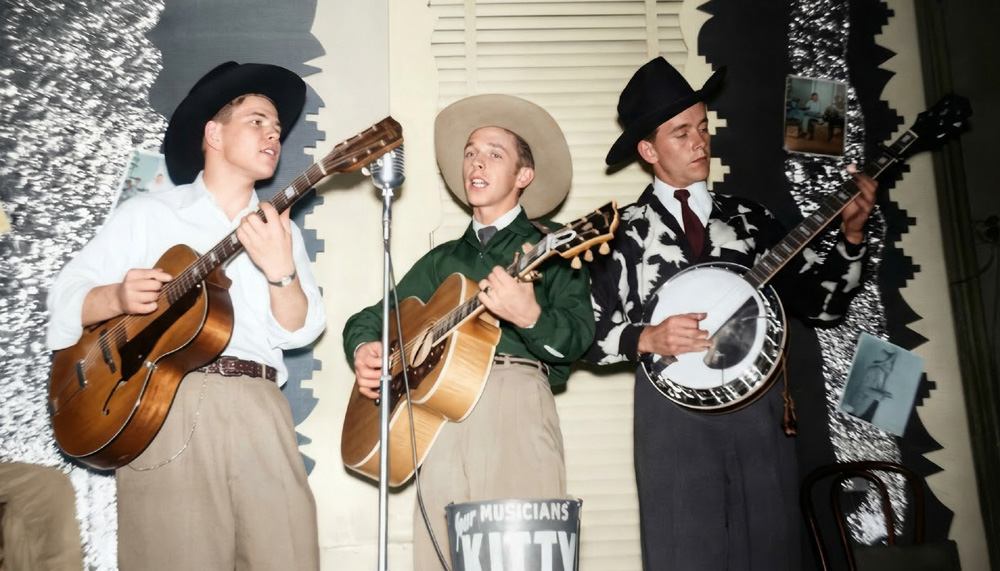
This
picture was taken in the winter of 1948.
Roy Clark and Pete on guitar and Buck Austin is playing the five-string
banjo.
Note:
This picture is also inlcuded in Roy Clark's Autobiography book.
|
Pete and Buck played a lot of places where his brother Frank couldn't go because he was only fourteen years old at the time. One place was an old fashion square dance in Meherrin, VA. They played the dance with The Clark Brothers who asked them to play with them in a fiddlers contest in Crewe,Va. the very next Friday. There was not a contest for singers but the Clark Brothers asked Pete to sing a Little Jimmy Dickens' song called The Brides Bouquet and the people applauded so long that they made up a prize and awarded it to Pete. They began playing regularly with The Clarks and one Saturday night, Roy Clark's dad was sitting in on guitar, and after the show Mr. Clark told Pete and Buck that they should come up to Washington D.C. and play some with Roy. The next Fall, Pete, Buck, Franklin, and another friend loaded up Pete's car and headed for Washington D.C. |
|
They
rented an unfurnished house and moved in. Roy was fascinated with
the five-string banjo and would come over and play with them.
After about four or five weeks Buck, Roy and Pete got a job working
at a little place called The Camden Tavern. Franklin couldn't
play with them because he was too young and decided to go back
home. These shows were the first performances in the Washington
DC area of what is now known as bluegrass music today.
|
|
In the Fall of 1949, Pete, Roy Clark and a bass player named Curley Irvin, worked through the winter at a place called Joe Del's Bar and Grill and would became the last time that Pete and Roy worked together as a band. |
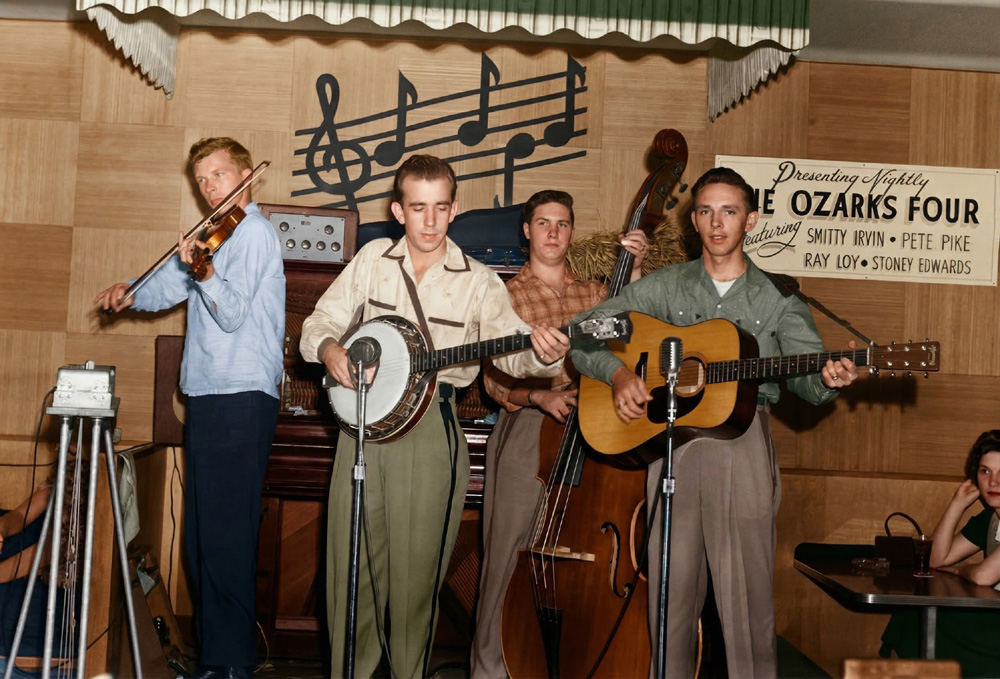
Ozarks
Resturaunt Washington DC - 1955
| Pete got married in 1952 and was released from the service in early. When he came out of the service in 1954, Pete and his wife took about a thirty-day honeymoon. After the honeymoon, Pete went back to D.C. then and looked up Curley Irvin to find a banjo or mandolin player to play with. He told Pete there was a boy named Buzz Busby that played pretty good mandolin, and was looking for someone to play with. Pete called Buzz up and they began performing together. | |
|
About this same time, Pete began working with Ben Adelman to get a record contract. Ben worked with Pete two days a week for about four hours a day, working on songs and helping Pete improve his diction. One of the first songs that they worked on was a pop song which Ben had written titled I Can See an Angel Walking. Pete worked for about three months at changing the pop tune into a hillbilly tune, and the final cut of the song was recorded in the summer of 1954. |
|
|
Scotty Stoneman was undoubtedly one of the best fiddle players Pete had ever heard at that time and he worked with Pete on some of his shows. Scotty agreed to do the session on I Can See an Angel Walking with Pete and played on most all of the records that Pete recorded from then on. To this day, Pete still considers Scotty Stoneman to be the best bluegrass fiddle player that he ever worked with. |
|
| I Can See an Angel Walking was released in late summer of 1954 and was picked by Billboard Magazine as a five-star pick hit. It began to climb the charts and Wade Holmes, who played lead guitar on the session, stopped Pete on the street one day and informed him that it was high up on the charts and climbing. I Can See an Angel Walking went to No. 1 in Virginia and Maryland districts and several other states before Pete really knew what was happening. |
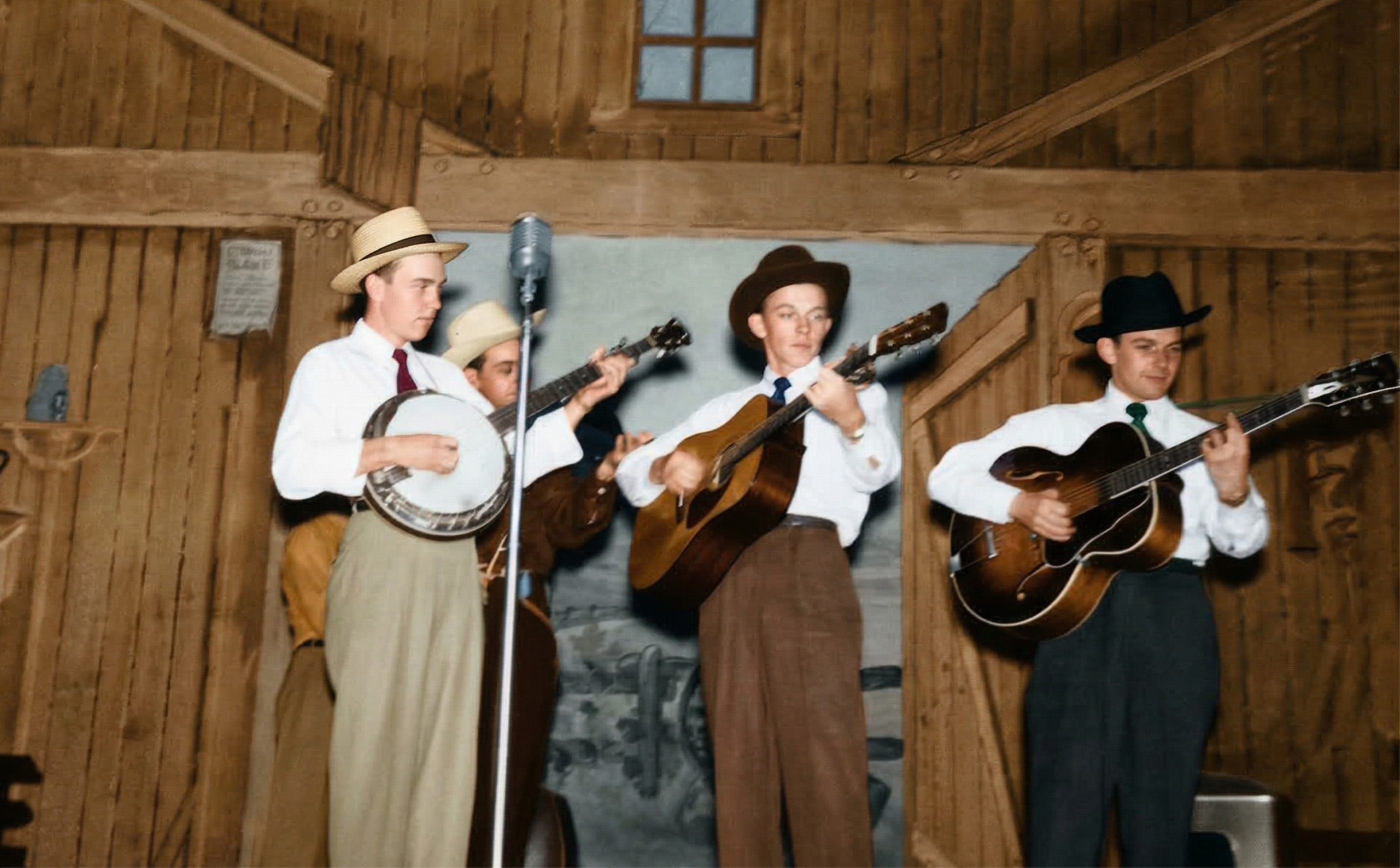
Smitty
Irvin, Toby Stroud (back), Pete Pike, & Dean Queer
- WWVA Jamboree Wheeling,
WV - 1952
| In the spring of 1950, Pete was looking to get back to the kind of band he was more used to playing with a banjo, mandolin, and a fiddle player, and while talking to Curley Irvin one day, Pete learned that Curley had a son that played the five-string banjo but wouldn't come up to DC. Curly told Pete that maybe if he would go down to Shelby, N.C. and play some with him, he might like it and change his mind. | |
|
Pete went to North Carolina and spent a week with Smitty Irvin and convinced him to come back with him, and the three of them started playing the clubs all over the DC area. In January of 1951, they went to Atlanta to work with MovieTime USA for about three months and also played a radio show on WEAS in Decaded, Georgia but wasn't long before they returned back to Washington playing the clubs again. |
|
|
In the fall of 1951, Johnnie and Jack were booked in the Virginia, Maryland, and D.C. areas and Pete and Smitty palled around with them on some of their show dates. They decided that performing shows was what they wanted to do, not just playing the clubs. The next Saturday night, after returning home from a club date, they were listening to Bill Monroe who was playing the last act on The Grand Ole Opry and Pete called Bill to see if he needed any musicians. Bill told Pete that he couldn't use anyone at that time, but he knew someone that could and told him that Don Reno was being inducted into the armed services and Toby Stroud, who was working on the WWVA Jamboree in Wheeling,WV and would need someone to replace him. As soon as Pete got off the phone with Bill, he called Toby in Wheeling and they auditioned over the phone. Toby told them to be in the WWVA studio at 5am on Monday morning and they loaded the car and headed for West Virginia. They arrived at the station by 5am that morning to play the first show. Their first song was a duet by Johnny and Jack (Let Your Conscience be Your Guide), and they were now doing what they really wanted to do: playing shows. Curley Irvin, who is Smitty's dad, took over their club dates in DC and they worked at WWVA until Pete was inducted into the service in 1952. Smitty was called into the service about six months later and that became the last time they worked together until about 1955. |
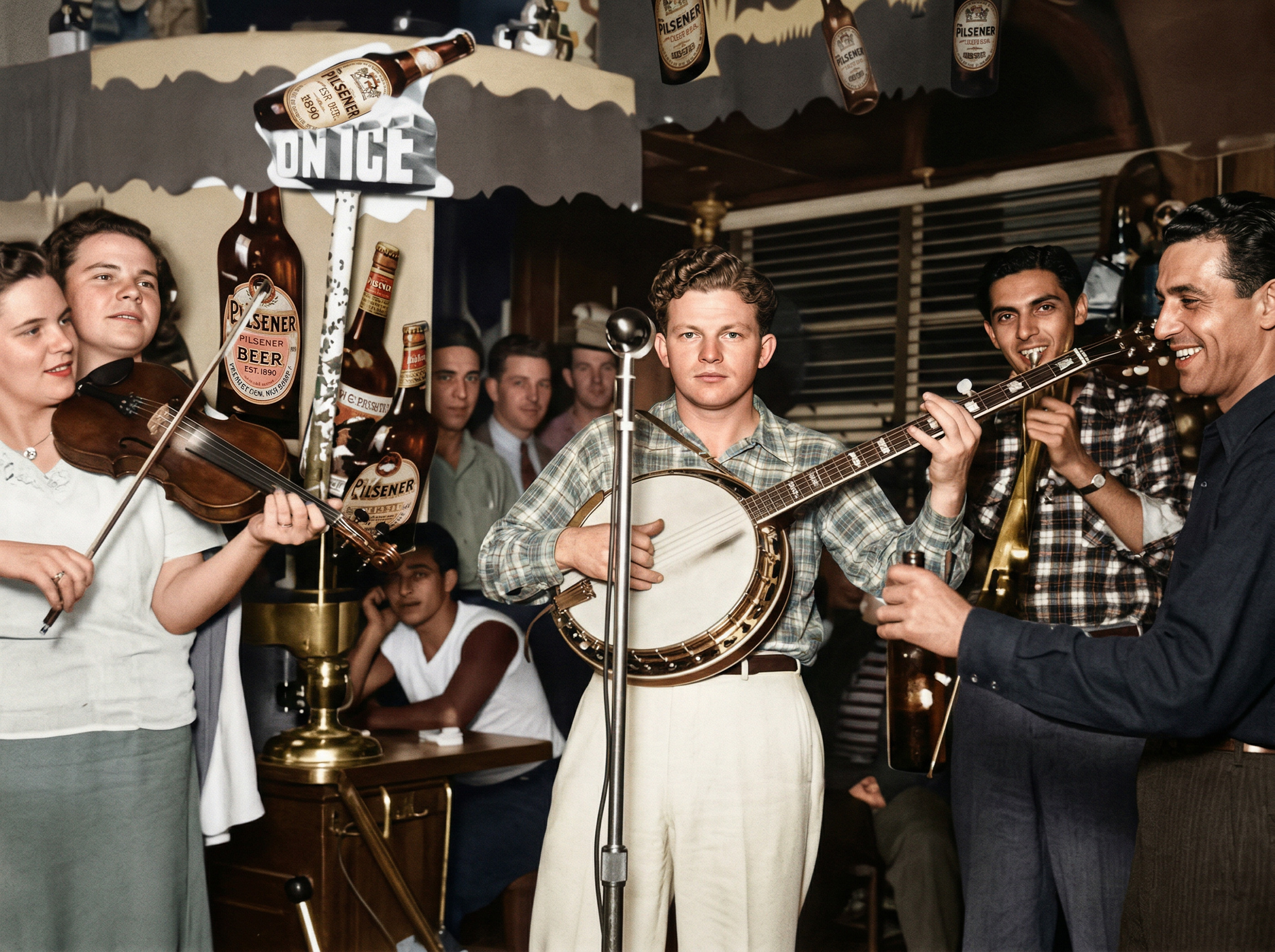
Johnny Hall, Don Stover, Lee Cole, & Pete - Pine Tavern, Washington DC - 1954
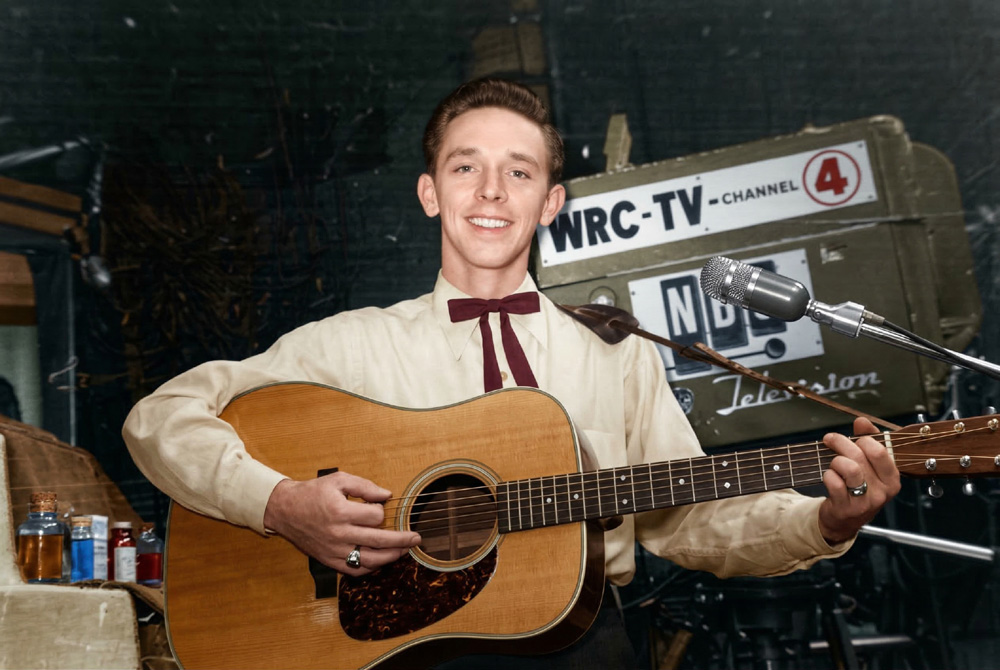
| During this same time, Buzz Busby, Curley Irvin, and Pete took a job at a place called The Pine Tavern in DC. They had played The Pine Tavern for about two months when WRC TV Channel 4, in Washington DC, called them to play a five-day-a week television show and wanted to come down to The Pine Tavern to check them out. Buzz and Pete put their heads together and decided they needed a couple more members and a band name before they came down to hear them. | |
|
Lee Cole had taken Curley's place on the bass because his son, Smitty had returned from service and he had gone back to North Carolina to play with him. Pete got on the phone and hired Donnie Bryant on the five-string banjo and Johnny Hall on the fiddle. |
|
|
Neither Pete nor Buzz had a full band before this time so they came up with the band name of Pete Pike and Buzz Busby and the Bayou Boys and then made an appointment for the TV guys to come down to view their show on a Friday night two weeks later. |
|
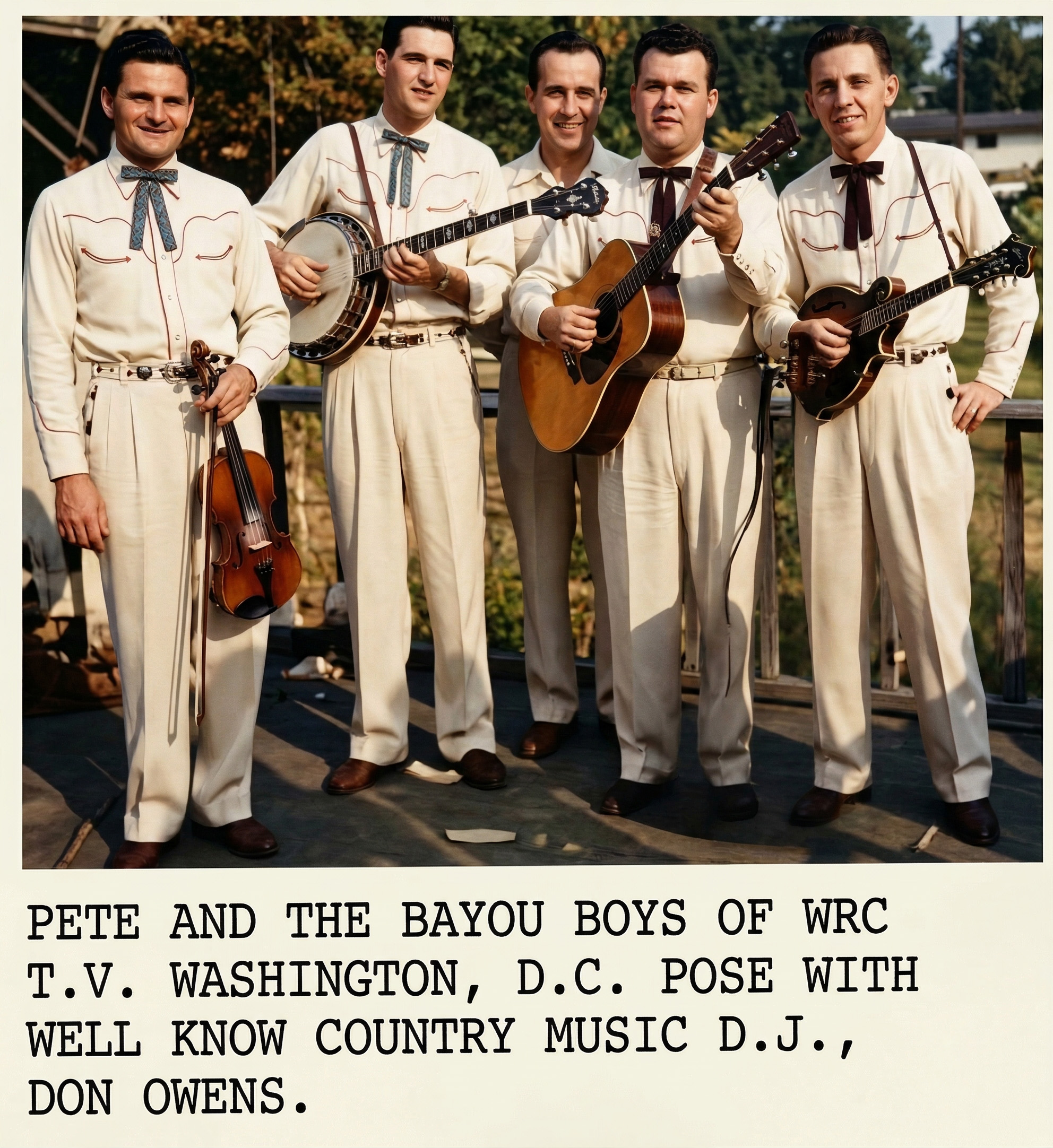 |
|
|
There was a big music contest in Warrenton, Virginia on the weekend before that appointment and since Pete already had a hit record on the charts, he and Buzz wanted to enter it. They got matching uniforms and entered in the contest down in Warrenton. Somehow the word got out that they were going to be there and twelve thousand screaming fans turned out for the show. When they walked out on that stage you could not hear one thing they said or played. |
|
|
They had entered each category and won every event. The judges got with them after the show and asked if we would be willing to share some of the prizes with other groups, which they agreed to do. Pete took first place for the vocal category and gave up the award for the guitar competition. Buzz Busby took second place for vocals and gave up the award for mandolin. Donnie Bryant took first place in the banjo and Johnny Hall took first place in the fiddle categories. The greatest part of that weekend for them was the next Monday morning when the Washington Post and Times Herald did a full-page layout on Pete and the band. |
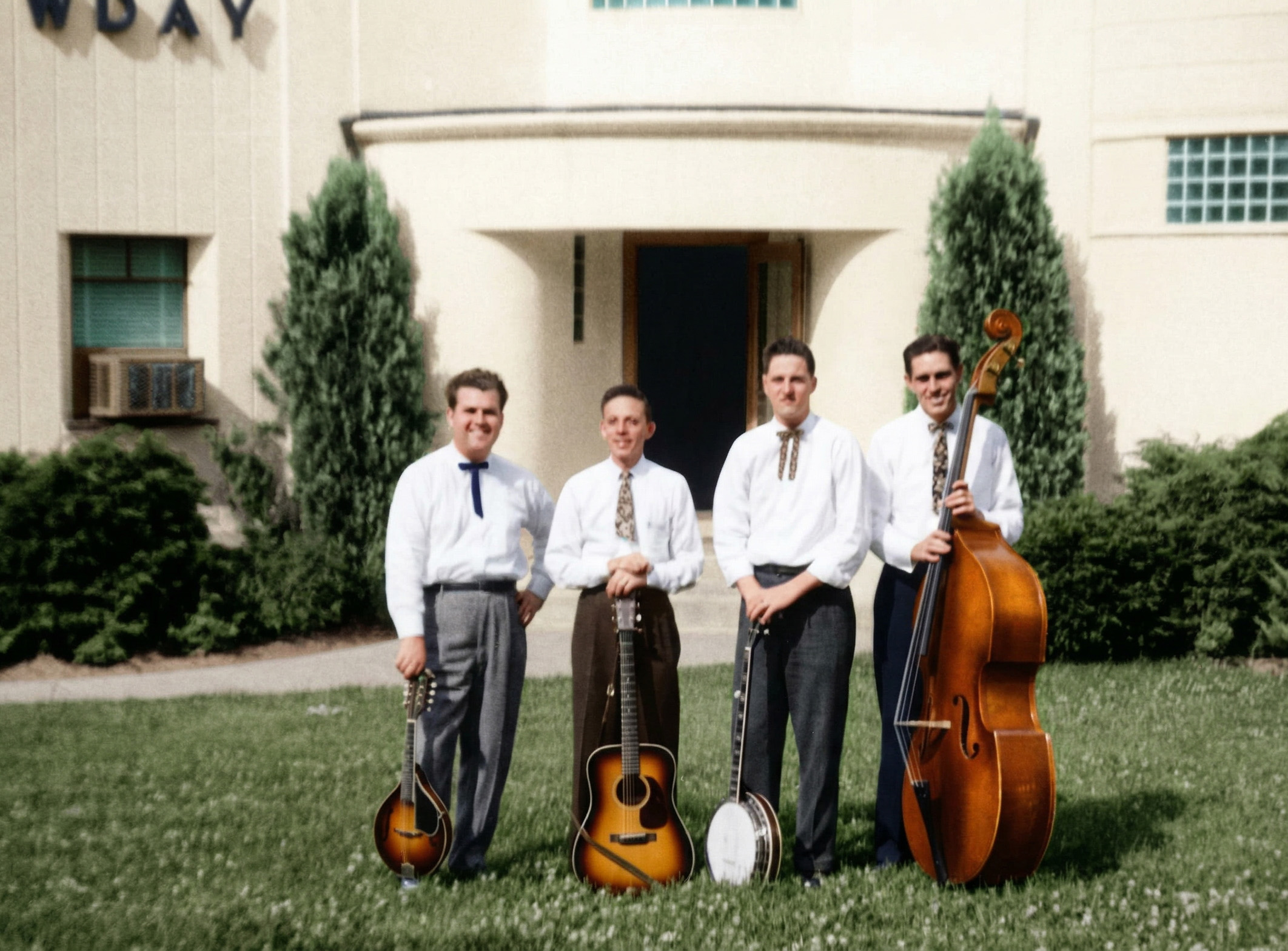
Buzz
Busby, Pete Pike, Donnie Bryant, Lee Cole - WGAY
Radio - Wheaton, MD - 1947
| The guys from WRC TV came down the next weekend for the review and they were looking for a hillbilly band, and The Bayou Boys fit the bill … a real hillbilly band and they were hired for the TV show, The Hayloft Hoedown. | |
|
They called them down to the station and told them that in order for them to play on the TV show, they would have to join the Musician's and Actor's Unions which was going to cost each one of the band members about four hundred dollars. They went to work on getting the money together and joining the unions, got it done, and did the first show. Pete had also brought Don Stover in from Beckley, West Virginia to play five-string banjo because Donnie Bryant had gone back to school and could not do the show. |
|
|
The Hayloft Hoedown show was a big hit; something a lot of those people had never seen before … a real Hillbilly show. Acts included a lot of the same type comedy as sweeping up after the mule train and a lot of trick camera work. Pete and Buzz formed a comedy act called Ham and Scram. |
|
|
The Ham and Scram act required frequent changing of clothes, which was accomplished in about twenty seconds and the audience could not figure out who they were. Pete and Buzz had a great time including a comedy act in the show. In the last couple months of the show they performed a verse and chorus whatever was on the Billboard Top Ten every Friday. The Hayloft Hoedown was a fast-paced job. They were required to be at the station at 10am to rehearse the show for three hours, and then run through the show. After that they did the live broadcast from 2:00pm until 2:30pm. |
|
|
The third day they were on, John Miller called and wanted them to play a Sunday show at Watermelon Park, down in Berryville,Va. and Pete told him they would only have one day to advertise and was afraid that they could not draw a crowd with that short notice. John told them that it was a daytime show and that he would pay them anyway with a crowd or not and on the day of the show seven thousand people showed up. |
|
|
Pete and Buzz worked together off and on until 1963 and finally went separate ways due to Buzz's problems with substance abuse and would not work together until 1976 and in again 1985. Pete enjoyed helping Buzz record his records and considers Buzz to be one of his best friends. To this day, Pete considers him to be one of the best musicians that ever picked up a mandolin. |
|
|
Washington DC was the Hillbilly Capitol City and Pete and Buzz did an awful lot to further 'hillbilly bluegrass' music that was so poplular. They had some of the best bluegrass pickers in the country playing with us at times. Bill Emerson, as Pete recalls one night in a small club, played with them and did a Bill Monroe song, I hear a Sweet Voice Calling, and when they finished the song, Bill turned to Pete and said, "I have never heard anyone sing that song that good before." He said, "I've got chill bumps." Bill was singing the baritone with Pete and they performed in perfect pitch. |
|
|
Charlie Waller would also come and sit in with them on nights off and sing some Hank Snow songs. He frequently would work together with Pete from time to time. Scotty Stoneman was another great musician that graced the stage with them. "He's just one of the best", says Pete. "Listen to him play on the record Lonesome Wind Blues, and you will agree." Scotty helped Pete on most of his records. Some of the other artists in the area in the 50's were Jimmy Dean, Smitty Irvin, and Billy Grammar. |
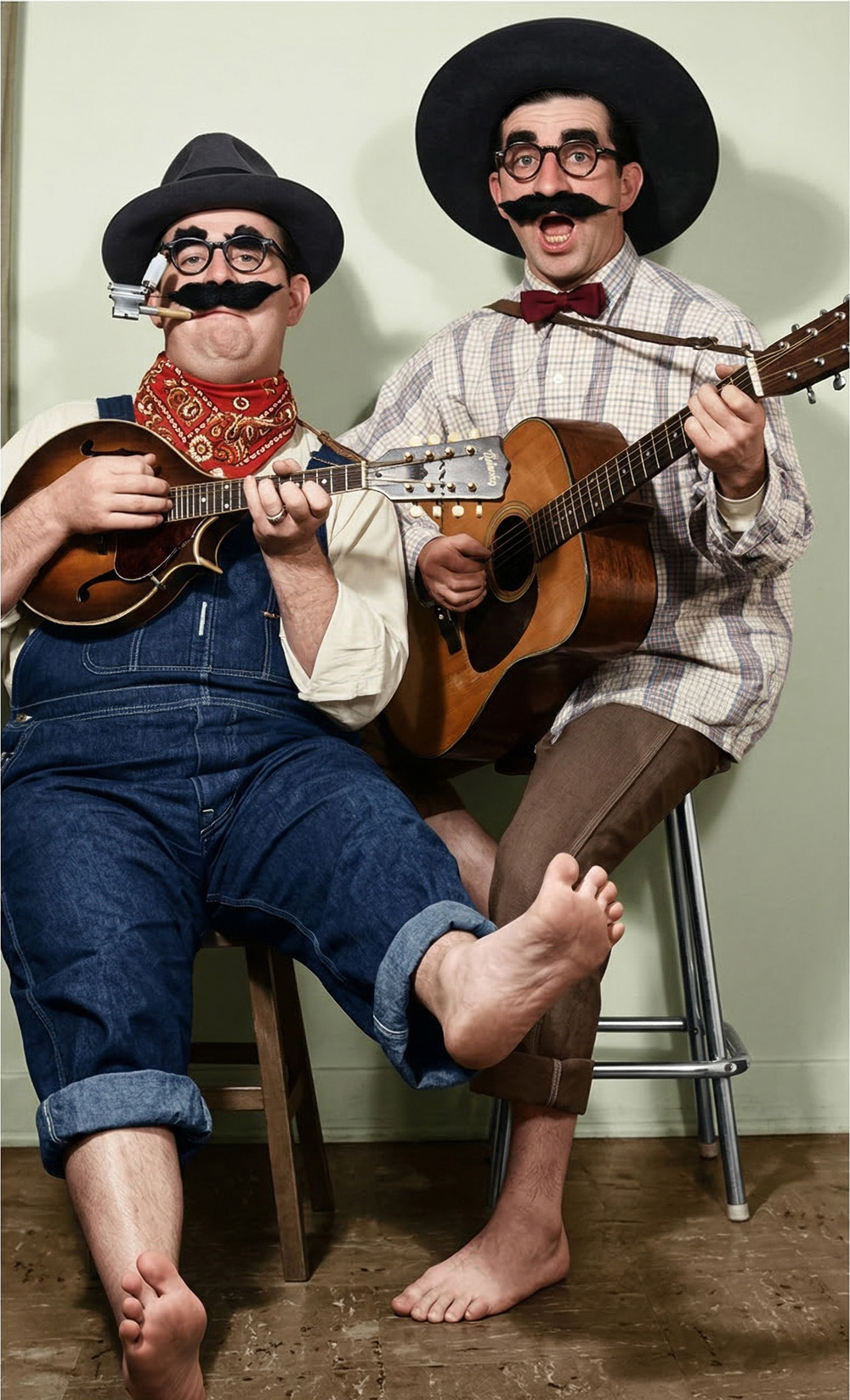
Ham and Scram (1954 -55) - The comedy act of Pete Pike & Buzz Busby
|
Buzz and Pete did their next recording session in 1955. The songs: I'm Walking Alone, Yellow Leaves, Don't Take Her Love for Granted, and I'm burning all your Letters. In 1956 Pete recorded Just Between Us Two, At my Side, No Peace of Mind, and Friend of the Bride. |
|
|
In 1957 Buzz and Pete did Lost, Lonesome Wind Blue, Mandolin Twist and Pete did I Don't Mind (also with Buzz's help) and All Because of My Jealous Heart. These were all recorded in the Ben Adleman Studios on Cedar Street in Washington DC. In the House of the Lord was cut on the first session and released on the flip side of the first record. After this they didn't record any records for Starday Record Company until 1960 and those were done for Rebel Recording Co. Pete also recorded In the Jailhouse Now with help from The Woodward Brothers (steel and electric guitar) and was recorded in a studio off one of the circles in downtown DC. |
|
|
In 1958, Pete cut a session with Buzz, Bill Emerson, and John Hall and recorded Banjo Whiz, Windy Strings, and Mandolin Tango. This was also recorded in Ben's studio on Cedar Street in Washington. Don't Come Running Back to Me was also recorded in DC and not in Takoma Park, Md as has been previously been printed. |
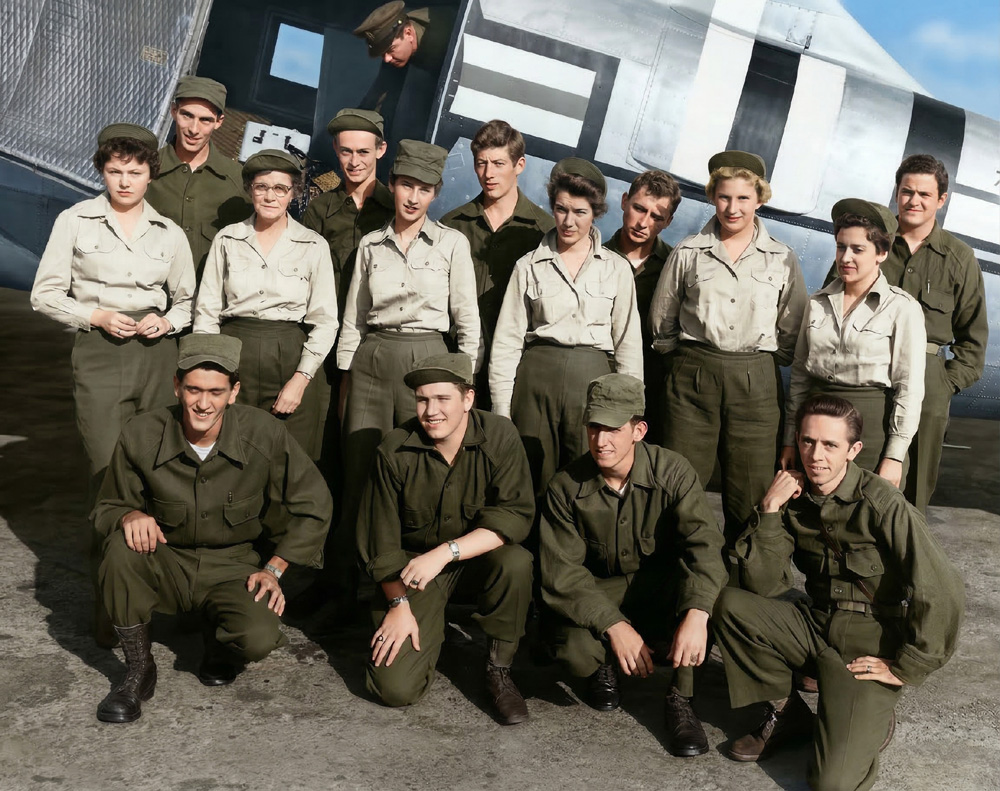
Pete's USO Show 6-month tour to the Far East - 1955-56
|
When the Hayloft Hoedown show came to an end, Pete received a call from the Pentagon asking him to consider taking a band overseas to the Far East to entertain the troops. They told him he would be paid and would be the first group ever paid to go overseas to entertain. The USO had a contract with the government to provide free entertainment the USO would be paid one hundred thousand dollars to let them go. Pete's record, I Can SeeAn Angel Walking was still in the charts at that time, so Pete took Johnny Hall from the TV Show, Ray Loy on electric Guitar, and Stoney Edwards on the bass, to make up the band. They also had a five-girl and five-boy clogging group and a three-month contract with a three-month option. |
|
|
Pete started recording for the Rebel Records Company in 1960 and was the first recording artist for Rebel. He re-recorded his first record (I Can SeeAn Angel Walking) and another song he had written five years earlier called Napanee. On this same session, he also recorded Alone and Forsaken and Blues on my Mind. This session was done at the Owyn Bradley Studios in Nashville, Tenn. The musicians were Floyd Cramer on piano, Chet Adkins on Guitar, and Pete Drake on steel guitar. |
|
|
Pete
did a Christmas session for Four Star Records in 1956 with the
same musicians. They recorded Happy Birthday Dear Jesus
and An Old Fashion Christmas. Those were released during
the Christmas Season in 1956. |
|
| He also recorded Making Love to a Stranger, Cold Grey Dawn, and a couple of songs with Buzz for Starday Records. |
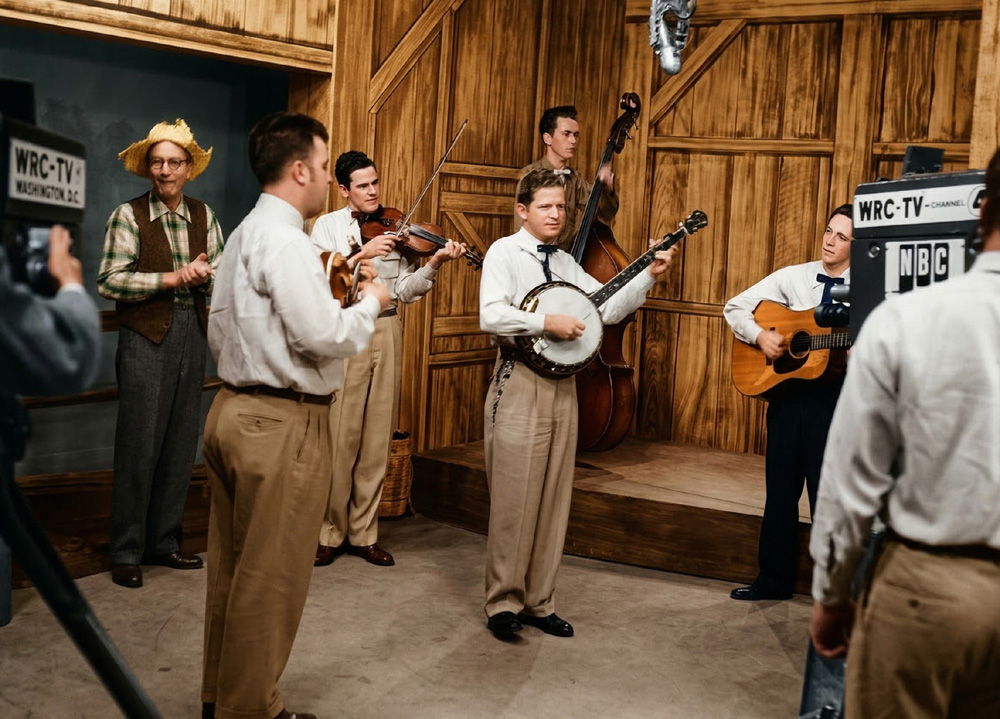
Hayloft
Hoedown - 1954
Emcee
Mike Huneycutt, Buzz Busby, Johnny Hall, Don Stover, Buck Austin and
Pete Pike
|
A local DJ played Making Love to a Stranger for George Jones when he came to town on a show date, and George wanted to record it, but the record company thought it was a little too spicy at that time, even though George wanted to do it. |
|
|
They rented Watermelon Park in the summer of 1958 and booked such as The Louvin Brothers, The Stanley Brothers, George Jones, and others. George had not recorded his firt big hit, White Lighting at this time and the radio staion kept him with them for a whole week to play wherever they wanted him to because he would show up a week late if they didn't. Even back then he was "No-Show Jones". They also had a fiddler's contest with John Hall and Scotty Stoneman. They were good friends but they loved to compete against each other in contests. Pete got John and Scott together to do twin fiddles on a song that Buzz wrote called I'll Always Wonder Why. Buzz played guitar on it. This was cut in 1960. On the same session, they did a song that Buzz and Pete wrote together called Cotton Dice. It sold great in England. Buzz played guitar on both of these. This is the same session Making Love to a Stranger and Cold Grey Dawn were recorded on. These were all recorded in Ben Alderman's Studios in Washington D.C. They recorded the songs The Legend of the Stars and Bars and On Top of the Hill in a radio station studio in Martinsville, Va. that Jim Eanes was working for. Jim was the A&R man for the session. They were also working for the Old Dominion Barn Dance every Saturday during this time. |
|
In 1963, when Buzz and Pete again decided to go separate ways, and Pete decided to take flight training lessons and got his pilots license. He bought a new Cessna Sky Hawk in 1965, and used it to do a lot of traveling until 1972. |
|
| In 1967 and 1968, Pete started a record label, VRC Records, and recorded four or five artists. He found that to be to very confining and not giving him very much free time. He also started LeRite Publishing Co., registered with BMI, and bought a 46-foot yacht and in 1967 he cut I'm Just Not Sure and Through None Stop Express, released on his label. The following year he released I Can See An Angel and a Hank Williams' number entitled Alone and Forsaken, also on this label. These were done in the Archer Moore Studio in Nashville. | |
| In 1969, Pete recorded some songs for the John Major Studios in Waynesboro, VA which were not all released. The numbers he did then were Somewhere in Georgia, Baby Go Bye Bye, I Had to Have Her, Have Told You Lately That I Love You. The first two were released on the John Major label MRC; the last was released on Pete's label. | |
|
In 1970, with the help of Carlton Haney, Pete began holding bluegrass festivals on a 110-acre farm that he owned down in Amelia, VA. At the time, Carlton was having festivals at Watermelon Park in Berryville, VA. He was the manager for Don Reno, Red Smiley, and The Tennessee Cutups and also ran the New Dominion Barn Dance and promoted shows up and down the East Coast. Pete worked with Carlton a lot at that time and it was his record label that Little Bitty Teardrops was released on. They had a reunion of 'The Hayloft Gang' at one of the festivals in 1970. The Hayloft Gang back together again: Don Stover, John Hall, Buzz Busby, and Pete Pike, along with Jack Stoneman on the bass for that show. After playing the festivals until 1974, they didn't do as much music as they had been, mostly just on the weekends. |
|
|
In 1978, the Pike Family bought a farm equipment dealership and worked at that until 1982 then sold out and went into the timber business. On October 13, 1996, they held an auction sale and sold the timber equipment. Pete opened a restaurant in Amelia the same day they had the sale and wasn't expecting a booming business, but as it turned out, Pete employed sixteen people and had to add 1000 square feet on to the building to accommodate customers. It became too much for Pete to keep up with so he leased the restaurant out and Namaw's Country Diner that is still thriving today. |
|
|
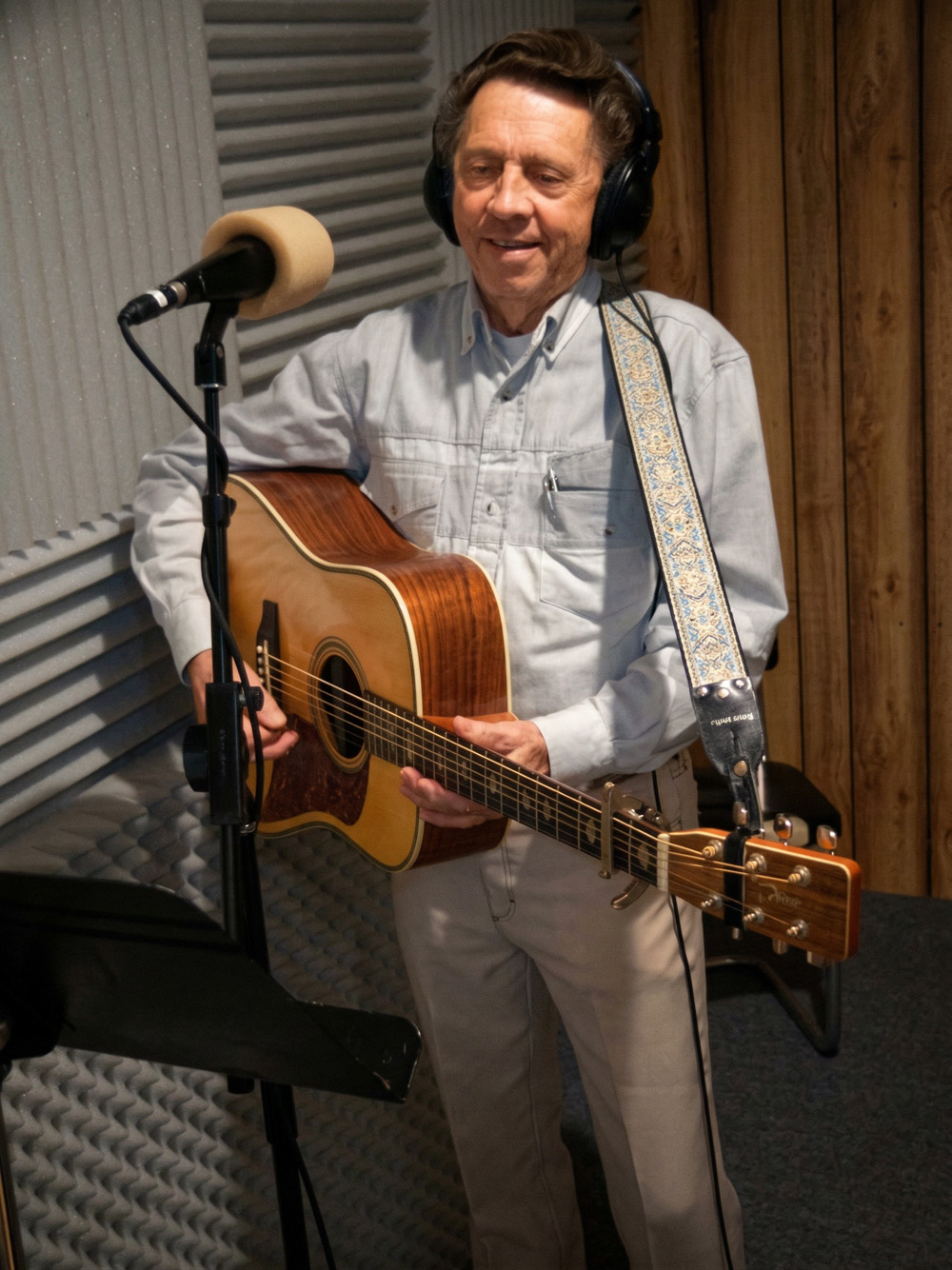
Recording session Flat Five Studios - Salem, Va, in 2004 L
to R: Pete Pike, The Black Diamond Band - Rodney Riffe (Bass),
Scott Patrick (Guitar), |
|
|
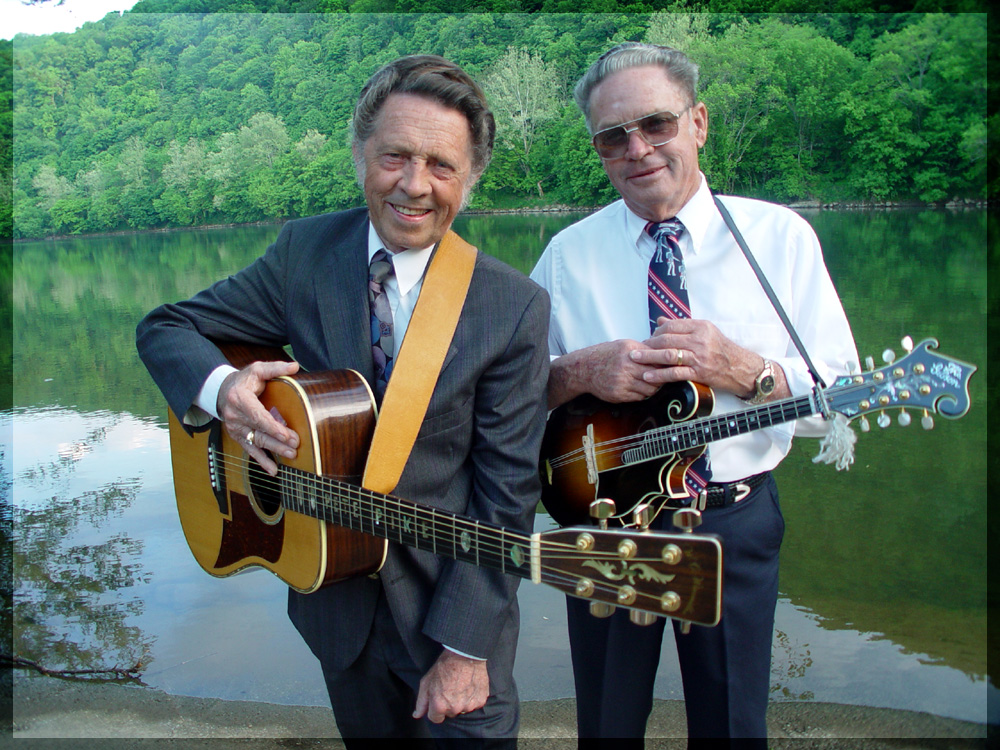
In January of 2004, Pete Pike, along with his brother, Franklin, took the Black Diamond band and fiddler, Jerry Wood into the Flat Five Recording Studios in Salem, Virginia to lay down tracks for a bluegrass CD. They hit the ground running and the final product reflects remarkable songwriting and recording talents of the veteran and seasoned ''Hillbilly" artist, Pete Pike. Black Diamond provided the driving force with incredible tracks of Donnie Marrs' mandolin on Little Bitty Teardrops, wonderful 'swing-style' fiddling on Sweet Virginia Lou by Jerry Wood. Eddie Marrs gave it all on banjo and dobro and Scott Patrick's driving flat-pickin' licks filled in the middle while Rodney Riffe drove the tempo on the dog-house bass. Pete's brother, Franklin Pike, also provided solid rythym licks on his Gibson F5 mandolin. Pete's distictive vocals were backed up with the harmonies of Black Diamond's, Donnie & Eddie Marrs on tenor, and the mellow baritone of Rodney Riffe. This legendary recording on the Copper Creek Record was released the first of 2005 |
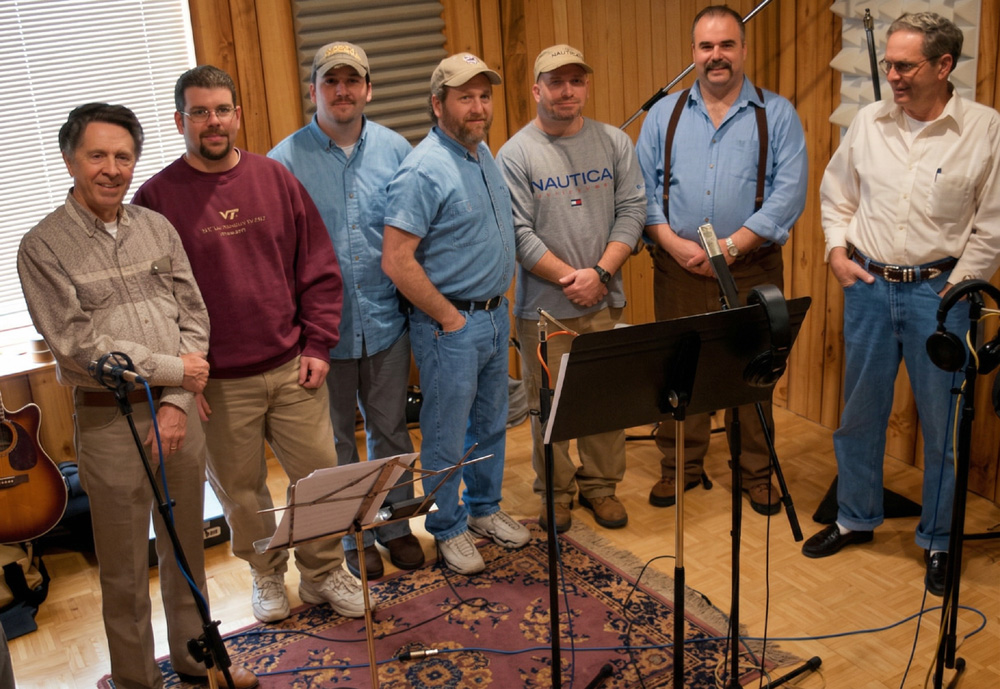
Recording at Flat Five Studios - Salem, Va. in 2004
L
to R: Pete Pike, The Black Diamond Band - Rodney Riffe (Bass), Scott
Patrick (Guitar),
Eddie Marrs (Banjo), & Donnie Marrs (Mandolin) - Jerry Wood (Fiddle),
and Frank Pike (Mandolin)
|
|
| Pete Pike passed away on August 27, 2006, at age 76. He is buried at Little Flock Primitive Baptist Church Cemetery in Wilsons Corner, Amelia County. While never a huge star, Pike had his fair share of fame and success, leaving a legacy of excellent country and bluegrass music recordings for future generations to enjoy. - (Read Obituary) |
| Franklin Pike passed away at age 91 on January 06, 2025 - (Read Obituary) |